
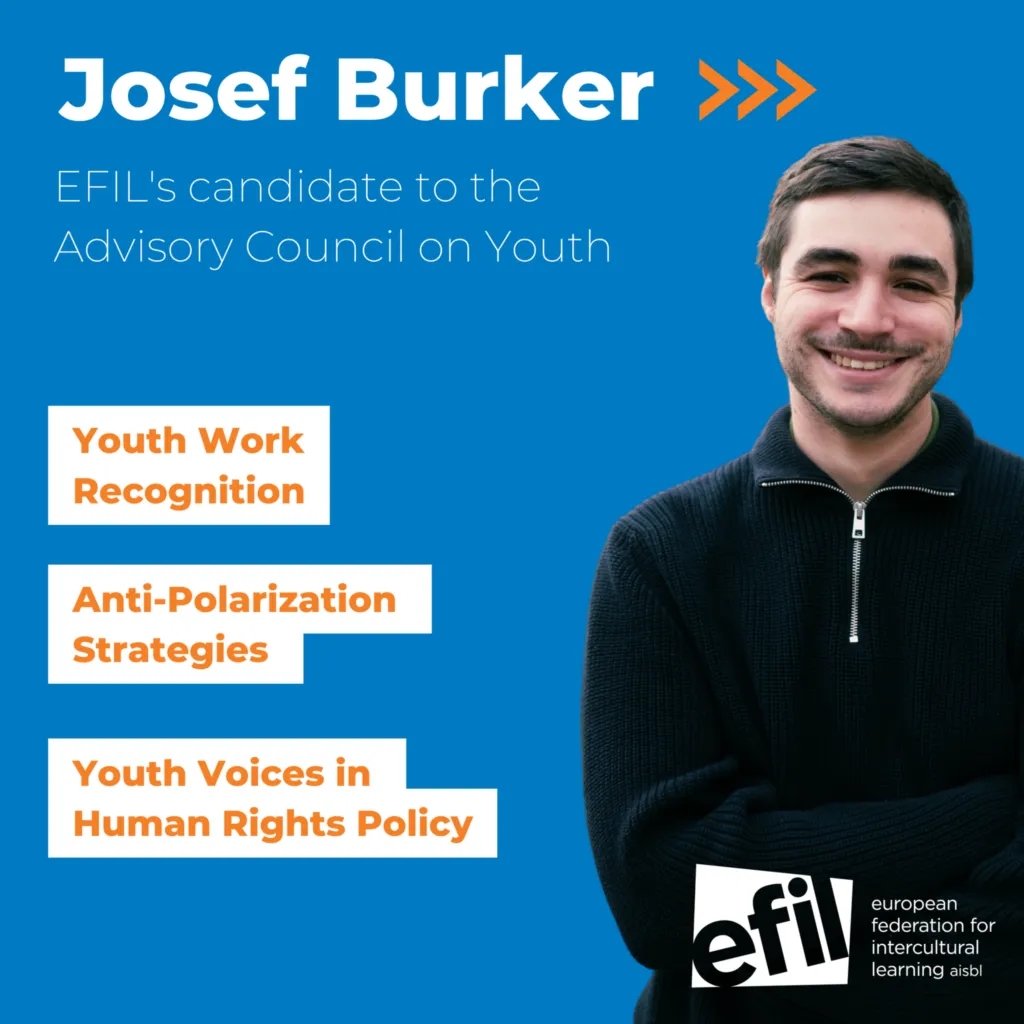
Hello! My name is Josef Burker and I’m honored to be EFIL’s candidate for the Advisory Council election this year. As an experienced youth worker, trainer, volunteer and student activist, I bring years of experience and necessary know-how on the topics I think are both important and quintessential for youth movements. The following points are all supported by a plethora of expertise by EFIL’s network and substantiated on the principles of inclusion, diversity and equality.
1. Growing Youth work: Shaping futures through shared progress!
I am committed to empowering and strengthening youth work movements. Having actively participated in two such movements for several years and being engaged in EFIL’s network for a decade,I have witnessed both the challenges and immense potential of European youth work-based initiatives.
Aligned with the EU Youth Strategy to 2027 and the 3rd European Youth Work Convention’s Declaration, my goals within the Advisory Council will be to develop and advocate for youth work movements in their diverse local and regional contexts, considering their needs and unique situations. This includes addressing structural challenges on the supranational level, ensuring financial sustainability and securing policy recognition, to challenges in the national level, like advocating for better recognition of non-formal education.
Reaching youth is also a matter of direct community engagement: Digital youth work as a tool to compliment and expand progress on the ground is a tool AC representatives can advocate for. These, among others, are essential to affirming youth work as a pillar of democratic participation and social cohesion in Europe.
I strive to be a strong and dedicated voice for youth work-based organizations and movements. As someone shaped by EFIL’s democratic citizenship education processes, I understand the transformative power of youth work and volunteer-based organizations —not just in empowering young people, but in motivating them to be active in civil society. For this reason, I believe youth work must be recognized, supported, and expanded to build a more engaged and resilient Europe.
Key actions:
✔ Advocate for Policy Recognition – Push for greater recognition of youth work and non-formal education in CoE youth policy and beyond, particularly in co-management settings and youth sector strategies, advocating for financial sustainability for youth organizations.
✔ Strengthen Local-Regional Connections – Engage in dialogues to bridge gaps between youth workers, local decision-makers and international policy frameworks as well as promoting tailored solutions for regional challenges.
✔ Promote Digital Youth Work & Innovation – Support and advocate for digital youth work tools to enhance accessibility and inclusion, particularly in rural areas and marginalized communities, as well as to target otherwise unreachable young people.
2. Breaking barriers, ending polarization!
The growing climate of division, compounded by the multiple crises, including war, post-COVID effects and the deepening social and economic divide, threatens the very democratic values and principles that bind us together. Polarization is not just a challenge for political discourse — it deeply affects young people, their outlook on the future, and, in the long run, the future development of societies. If left unchecked, it erodes trust, stifles meaningful dialogue, and weakens our hard-fought for democratic systems themselves. This is a priority I aim to streamline across all relevant projects in the AC, taking into account the unique contexts surrounding polarization and youth in different countries, by being a voice for actors that hope to break the divide through non-formal education, peace work, volunteering and democratic citizenship education.
There has to be a rebuilding of trust in our shared institutions, a sentiment I hope to bring to the Committee of Ministers and other relevant settings. As someone with years of experience as an elected student representative in a student union, representing up to 90,000 students and a wide spectrum of perspectives, I have seen that a vibrant democracy thrives on constructive debate and not division. A democratic process is built on respect, inclusion, and the ability to find common ground despite differences, and not on hate speech, discrimination and disdain for our shared European institutions. These are values I aim to integrate into my positions at the AC, including intersectional perspectives and intergenerational dialogue as a key approach in AC affairs.
It is also through my multicultural background as an Austrian-Egyptian, who was greatly influenced by EFIL’s intercultural efforts, that I believe I can work very well in international contexts and do effective advocacy for interest groups through the AC’s channels. With my educational background in multicultural schools in Egypt and South Korea, I can attest to the power of strategically using diverse perspectives and intercultural dialogue to foster an inclusive, forward-thinking community. It is through such environments I believe polarization fails to manifest, which I believe needs to be a priority.
Key actions:
✔ Mainstream Anti-Polarization in Youth Policies – Ensure youth work-based approaches to tackling polarization (non-formal education, peace work, intercultural dialogue) are integrated into CoE’s youth priorities and recommendations.
✔ Strengthen Intergenerational & intersectional Dialogue – Push for more structured engagement between youth representatives and policymakers through Parliamentary Assembly and Congress of Local and Regional Authorities sessions, making sure youth perspectives on polarization are heard.
✔ Raise Awareness – Utilize the AC’s sphere and access to INGO networks to facilitate debates and campaigns on combatting hate speech, misinformation, and rebuilding trust in democratic institutions.
3. Human rights: No youth left behind!
My educational background compliments my activism in human rights: In the course of law school, I gained insightful knowledge on the European Convention of Human Rights, the Charter of Fundamental Rights of the EU and international humanitarian law, to name the most relevant fields. Furthermore, my experience in youth work in EFIL is aligned in achieving the Sustainable Development Goals (SDGs) 16 and 14. In my double-major in Korean Studies, my Bachelor thesis explored the role of humanitarian NGOs in South Korea advocating for and fully realizing the human rights of North Korean defectors. This was built upon my experience as a volunteer in TNKR – Teach North Korean Refugees – based in Seoul. Outside of lecture halls, as a human rights activist, several projects I facilitated and accompanied throughout the years as international officer at my local faculty and university student union, directly or indirectly correlated to anti-discrimination, equality and equity, as well as the promotion and awareness of human rights. As a practical example, I lead the efforts of contestation of negative law school exams for students in the faculty union representing upward of 9,000 students, as well as for the University of Vienna union of students during the COVID years.
In my mandate, I aim to be a strong voice for the inclusion of youth voices in projects relating to human rights, social rights and human rights education, for example through active participation in projects like the CoE treaty European Social Charter and in affirming the foundational principles of the UN Convention on the Rights of the Child. The influence of the case-law of the ECHR on the development of young peoples’ lives is also an important aspect the AC can further focus on in regards to its work in human rights policy.
Key actions:
✔ Integrate Youth Voices in Human Rights Advocacy – Advocate for stronger youth involvement in human rights discussions, ensuring critical engagement with ECHR case law, in the European Social Charter, and other youth-specific policies in which the AC has a voice.
✔ Promote more Human Rights Education – Support the development of youth-centered human rights education programs, integrating them into the CoE’s Youth Sector Strategy and funding streams for non-formal education projects.
✔ Tackle Discrimination & Marginalization – Work within the several projects and committees with stakeholders, including steering committees and the Committee of Ministers, to ensure human rights and other policies consider youth perspectives from marginalized communities.
Find Josef’s video presentation below 👇🏽 Stay in touch: [email protected]